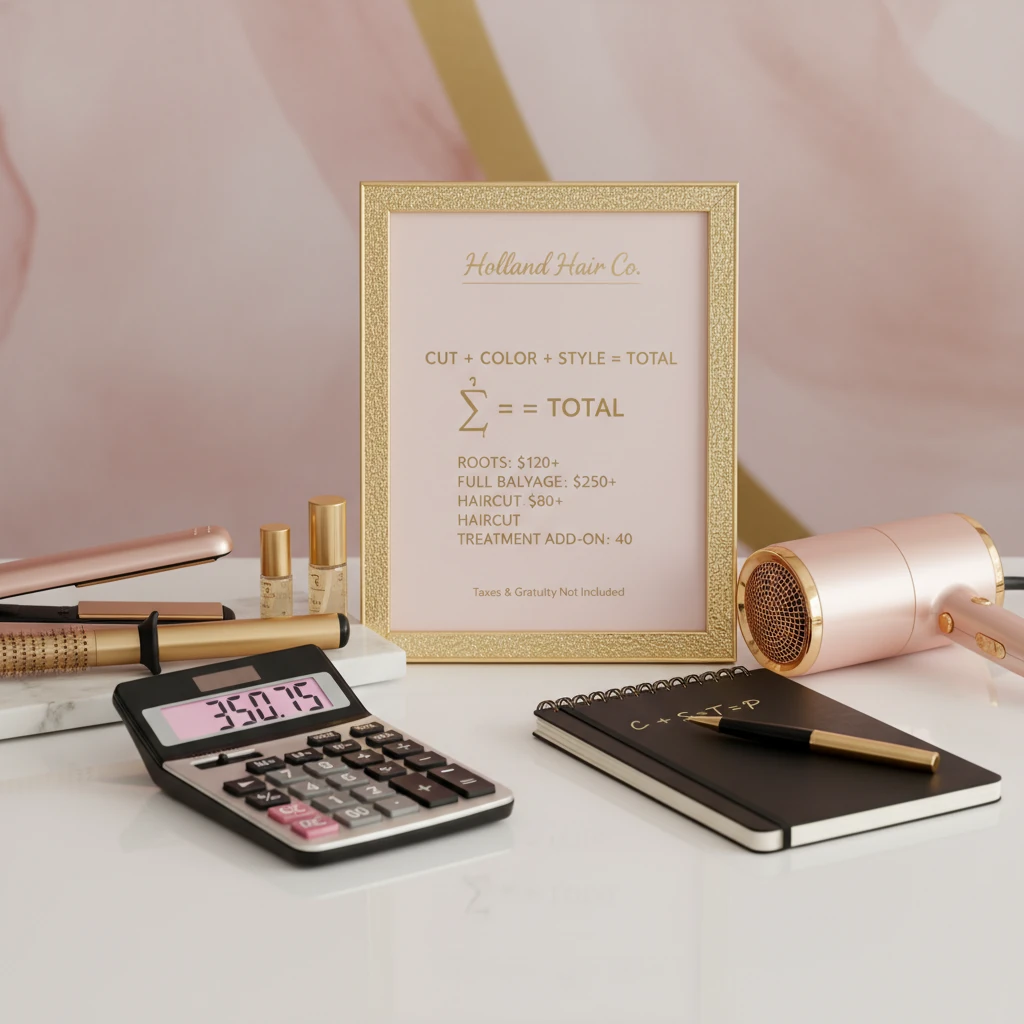
Hairstylist Pricing Formula for Booth Renters

Key Takeaways
- ✓The hairstylist pricing formula for booth renters starts with your total monthly expenses — booth rent, products, insurance, taxes, and personal take-home — then divides that number by your available billable hours. This produces your Freedom Rate: the minimum hourly rate you must charge to break even and pay yourself.
- ✓Most booth renters need to charge between $65 and $120 per hour to cover self-employment tax (15.3%), product costs, slow weeks, and take home a livable income. If your current rate falls below that range, you are likely paying to work.
- ✓Self-employment tax alone equals 15.3% of net income — a cost commission stylists never see in full. This single line item is the most commonly forgotten expense in every booth renter pricing formula.
- ✓A full schedule is not proof your prices are right. If you are booked solid but financially stretched, the problem is your rate — not your work ethic or your client count.
- ✓Recalculate your Freedom Rate every 90 days. Product prices, booth rent, and your income goals change. Your hairstylist pricing formula should change with them.
- ✓Never build tips into your required income. Set prices that work without gratuity so every dollar of tips is a true bonus — not a budget patch.
The hairstylist pricing formula for booth renters starts with your total monthly expenses — booth rent, products, insurance, taxes, and personal take-home — then divides that number by your available client hours. For example, if your monthly expenses plus desired income total $5,000 and you work 25 billable hours per week across 4 weeks (100 hours), your minimum hourly rate is $50. Most booth renters need to charge $65–$120 per hour to cover self-employment tax (15.3%), supplies, slow weeks, and still take home livable income. This formula is called a Freedom Rate: the minimum you must charge per hour to break even and pay yourself — before profit.
Hairstylist Pricing Formula for Booth Renters
My husband Justin said something to me a few years ago that I still think about.
"You do not have a hair problem. You have a business problem."
He was right. And for most booth renters, the biggest business problem is pricing. Not because you do not care about money. But because nobody teaches you the math.
Hair school taught you formulation and foil placement. It did not teach you how to calculate what you actually need to charge to pay your rent, cover your taxes, and still take home enough to live on. I learned this the hard way during my first year renting a booth: I was fully booked five days a week, running on caffeine and dry shampoo, and somehow still short on rent every other month.
The hairstylist pricing formula for booth renters that I am about to walk you through is what I used to fix that. It has a name: the Freedom Rate. Once you know yours, you will never guess at your prices again.
The Short Answer: How to Price Your Services as a Booth Renter
If you need the answer fast, here it is: add up every monthly business expense plus your desired personal income, divide that total by your available billable hours per month, and the result is your minimum hourly rate — your Freedom Rate.
Every independent hairstylist pricing formula for booth renters produces this same foundational number. For most booth renters, that number lands between $65 and $120 per hour. Where you fall in that range depends on your market, your booth rent, your client volume, and how aggressively you are reserving for self-employment taxes (15.3% of net income, owed by every self-employed stylist in the U.S., according to the IRS self-employment tax schedule).
If your current pricing sits below your Freedom Rate, you are not breaking even. You are effectively subsidizing your clients' hair appointments with your own financial stability — and working harder to do it.
The rest of this post walks through exactly how to calculate that number and what to do once you have it.
Why Salon Pricing Advice Doesn't Work for Booth Renters
Most pricing advice aimed at hairstylists was built for commission-based employees, not independent booth renters. The distinction matters more than most people realize.
A commission stylist works for the salon. The salon handles payroll taxes, provides products, covers credit card processing, and carries liability insurance. The stylist gives up 40–50% of her service revenue in exchange for those systems being handled for her.
A booth renter keeps 100% of her service revenue. But she also pays 100% of everything the salon used to cover: booth rent, products, insurance, scheduling software, processing fees, and the full 15.3% self-employment tax that commission employees only pay half of. According to the Professional Beauty Association, the average self-employed hairstylist spends between $1,500 and $2,500 per month on business overhead before taking home a single dollar.
That is why copying the pricing menu of a commission stylist — or even another booth renter whose expenses you do not know — will almost always leave you underpaid. Her math is not your math. Her Freedom Rate is not your Freedom Rate.
The hairstylist pricing formula for booth renters has to start with your specific numbers. Not averages. Not competitors. Yours.
This is also why so many booth renters feel financially confused despite appearing busy. A 2022 survey by GlossGenius found that 62% of independent stylists said they felt they were not earning enough relative to the hours they worked. That gap almost always traces back to a pricing formula that was never actually built around their real costs.
The Booth Renter Pricing Formula: Start With Your Numbers
Before you can calculate your Freedom Rate using any hairstylist pricing formula for booth renters, you need a clear picture of what it actually costs you to run your business each month. Most booth renters underestimate this by 20–30% because they track the big obvious expenses — booth rent — and forget the quieter ones.
Here is every expense category to include in your booth renter pricing formula:
Booth rent. If you pay weekly, multiply by 4.3, not 4. Most months have more than exactly four weeks. Using 4 instead of 4.3 underestimates your annual rent cost by roughly $1,000 at $250 per week. That is a meaningful error in any pricing calculation.
- $200/week x 4.3 = $860/month in booth rent
- $250/week x 4.3 = $1,075/month in booth rent
- $300/week x 4.3 = $1,290/month in booth rent
Product and color costs. A practical industry benchmark puts product costs at 10–15% of service revenue. For individual services, typical product costs break down like this: single-process color runs $6–$10 per client, full highlights run $10–$18 per client, balayage runs $8–$15 per client, a standard haircut runs $1–$3 per client, and blowouts run $2–$4 per client. Add 10% for waste, samples, and incidental supplies. Most booth renters undercount this line by at least $100 per month.
Liability insurance. Coverage typically runs $200–$500 per year, which is roughly $17–$42 per month. You need this coverage in place. If a client has an allergic reaction or slips in your space, you are personally liable without it.
Scheduling and booking software. Industry tools from platforms like Vagaro, GlossGenius, and Boulevard average $25–$50 per month.
Credit card processing fees. At 2.6–3.5% per transaction, processing fees on $9,000 per month in revenue equal approximately $261 per month — more than $3,100 per year. This line item is almost always missing from booth renter pricing formulas, and skipping it throws off every number downstream.
Continuing education, marketing, and supplies. Budget another $150–$300 per month for the category of everything else: classes, advertising, cleaning supplies, phone bill allocation, and minor equipment costs.
Self-employment tax reserve. This is the most frequently skipped line in every hairstylist pricing formula for booth renters — and the most expensive to skip. As a self-employed stylist, you owe 15.3% of net income for Social Security and Medicare. This is separate from federal and state income tax. Reserve it before you calculate take-home pay. If you are not tracking this, visit the pricing and money resources page for guidance on quarterly estimated tax payments.
Add all of these up. That total is your monthly business overhead — the amount you owe before you pay yourself a single dollar.
Step-by-Step: How to Calculate Your Freedom Rate
Now you have your expenses. Here is how to turn them into a Freedom Rate using the hairstylist pricing formula for booth renters — the minimum hourly rate you must charge to break even and pay yourself.
Step 1: Add your monthly business overhead.
Using sample numbers:
- Booth rent: $1,075
- Product costs: $517
- Insurance: $35
- Software: $40
- Processing fees: $261
- Other expenses: $200
- Total overhead: $2,128
Step 2: Add your desired personal take-home income.
Pick the number that actually covers your life — housing, car payment, groceries, health insurance, and real savings. Common monthly targets for booth renters working 4–5 days per week:
- $4,000/month = $48,000/year before personal taxes
- $5,000/month = $60,000/year before personal taxes
- $6,000/month = $72,000/year before personal taxes
For this example, use $4,500/month.
Step 3: Add overhead and take-home together.
$2,128 + $4,500 = $6,628 total monthly need
Step 4: Account for self-employment tax on gross earnings.
To net $4,500 after setting aside 15.3% in self-employment tax plus a buffer for income tax, you need to gross more than $6,628. Divide your total monthly need by 0.70 (reserving 30% for all taxes combined) to get your required gross revenue:
$6,628 / 0.70 = $9,469 required gross revenue per month
Step 5: Divide by your realistic billable hours per month.
If you work 4 days a week with 6 billable hours per day, that is 24 hours per week x 4.3 weeks = approximately 103 hours per month. Subtract 15% for cancellations, no-shows, and slow days: 88 realistic billable hours per month.
$9,469 / 88 hours = $107.60 per hour — your Freedom Rate
That is the minimum the hairstylist pricing formula for booth renters produces in this scenario: $107.60 per hour to cover every expense and pay yourself $4,500 per month. Any service priced below that rate — per hour of chair time — is costing you money.
If you are currently averaging $75 per billable hour and your Freedom Rate is $107, the gap is $32 per hour. Across 88 hours per month, that is $2,816 per month, or $33,792 per year in unrealized income. That is not a rounding error. That is a business problem with a math solution.
For more on making this shift without disrupting your client base, explore booth renter business systems that actually work.
How Much Should Booth Rent Factor Into Your Pricing?
Booth rent is your single largest fixed cost, and it deserves its own line of thinking inside every hairstylist pricing formula for booth renters.
A widely used salon industry benchmark is that booth rent should not exceed 20–25% of your gross monthly revenue. If you are paying $1,075 per month in rent, your minimum gross revenue target should be $4,300–$5,375 per month just to keep rent within a healthy ratio. If rent eats more than 25% of your revenue, either your rent is too high or your prices are too low — and the formula will tell you which.
Salon booth rental prices vary significantly by market. According to data from the Professional Beauty Association, urban markets with high foot traffic often run $250–$400 per week. Smaller towns and suburban markets typically average $75–$150 per week. The dollar amount matters less than the ratio. A $400/week booth in a high-volume city salon can be sustainable if your Freedom Rate supports it. A $150/week booth in a slow market can still be unaffordable if your pricing has not been calculated correctly.
One more consideration: booth rent is a fixed expense regardless of how many clients you see. A commission stylist's overhead scales with her volume — a slow week costs her less. A booth renter's overhead does not move. Slow weeks still cost you the same rent. That is exactly why your hairstylist pricing formula for booth renters needs to include a slow-week buffer of at least 10–15% of projected monthly income. Most booth renters see a 15–25% dip in client volume during January, late summer, and the weeks following major holidays. Price for that reality, not for your best month.
Also factor in your cancellation policy. A solid cancellation policy for booth renters protects the billable hours your Freedom Rate depends on. Without enforcement, even a correctly calculated Freedom Rate can fall apart in practice.
What to Do When Your Prices Feel Too High (But Your Math Says They're Right)
This is the part that does not get discussed enough. You run the hairstylist pricing formula for booth renters. The number comes back at $110 per hour. You currently charge $75. And your stomach drops.
Here is what to remember: the discomfort you feel about that number is not evidence that the number is wrong. It is evidence that you have been undercharging for a long time, and the math is finally showing you the truth.
A few things that help:
Give your clients advance notice — four to six weeks minimum. A simple, warm message works. You do not owe anyone a lengthy explanation. Something like: "Starting [date], my service prices will be updated to reflect my current costs. I truly value our time together and wanted to give you plenty of notice." According to a Vagaro industry survey, 68% of salon clients say they would not leave their stylist over a modest price increase if given advance notice. The fear of losing everyone is almost always larger than the actual loss.
Raise in increments if the gap is wide. If you need to move from $75 to $110 per hour, consider a $15–$20 increase now and another in four to six months. Steady, predictable increases are easier for clients to absorb than sudden large jumps.
Let demand validate your rate. When your books are consistently full three to four weeks out, the market has already told you that your prices are too low. A full schedule at a rate that does not cover your Freedom Rate is not success — it is volume without profit. For a detailed roadmap on raising your rates without losing the clients you have worked hard to build, read our full guide on how to raise your prices without losing clients.
Expect some client attrition and understand what it means. Research from Harvard Business Review consistently shows that retaining an existing client costs five times less than acquiring a new one. The clients who leave over a $10–$20 price increase were almost always your most price-sensitive clients. The ones who stay are your actual business foundation.
A full schedule is not proof your prices are right. A full schedule at a rate that meets your Freedom Rate — and leaves room above it — is the goal.
Common Pricing Mistakes Booth Renters Make
Knowing the hairstylist pricing formula for booth renters matters. So does knowing what breaks it. These are the most common pricing mistakes that keep independent stylists underpaid.
Copying another stylist's price menu without running your own numbers. Her booth rent, product costs, income goals, and client volume are different from yours. Her prices solve her math problem. They may have nothing to do with your hairstylist pricing formula or your actual overhead.
Building tips into your required income. Tips are not guaranteed. If your Freedom Rate depends on every client tipping 20%, your pricing is broken before it starts. Set prices that work without gratuity, and every tip after that is a real bonus rather than a budget patch.
Multiplying rent by 4 instead of 4.3. This single error underestimates annual rent by nearly $1,000 at $250 per week. That is enough to meaningfully distort your entire Freedom Rate calculation.
Setting prices once and never reviewing them. Product prices from major distributors including Redken, Wella, and Kenra increased 8–15% over the past two years, according to industry distributor reports. If your service prices have not moved but your costs have, your margin is shrinking every month — silently.
Ignoring credit card processing fees in your formula. At 2.9% per transaction, processing fees on $9,000 in monthly revenue cost more than $3,100 per year. That number belongs in your booth renter pricing formula from the start.
Forgetting the slow-week buffer entirely. Most booth renters see a 15–25% dip in volume during January, late summer, and post-holiday weeks. Pricing for your best month and living through your worst one is a reliable path to financial stress.
Not accounting for self-employment tax at all. This is the most expensive mistake on this list. Self-employment tax at 15.3% of net income is not optional and is not negotiable. If you are not reserving for it monthly, the IRS will collect it in April anyway — with penalties and interest added. The Solo Stylist Society — business education built for booth renters covers tax systems built specifically for independent stylists who need to stop getting blindsided at tax time.
FAQ: Hairstylist Pricing as a Booth Renter
How much should a booth renter charge for hair services?
A booth renter should charge based on her Freedom Rate — the minimum hourly rate that covers all expenses and a real take-home income — not based on what other stylists charge or what feels comfortable. Start by adding your monthly booth rent, product costs, insurance, self-employment taxes (15.3%), and your target personal income. Divide that total by your available client hours per month. That number is your floor. Most booth renters discover they need to charge between $65 and $120 per hour to actually make ends meet.
How much should you charge for booth rent as a salon owner?
Salon booth rental prices typically range from $75 to $400 per week depending on location, amenities, and market demand. Urban markets with high foot traffic often command $250–$400/week, while smaller towns average $75–$150/week. As a booth renter paying that rent, your service pricing must account for this fixed overhead cost regardless of how many clients you see — which is why the hairstylist pricing formula for booth renters matters more than copying what competitors charge.
How do you determine prices as a hairstylist?
Determine your prices as a hairstylist by calculating your Freedom Rate first — the hourly rate you must earn to cover all business expenses and pay yourself a livable wage. Add up every monthly expense: booth rent, color and product supplies, insurance, continuing education, scheduling software, and self-employment tax (15.3% of net income). Add your target monthly personal income. Divide the total by billable hours per month. That result is your minimum rate. Anything below it means you are paying to work.
How much do you tip a hair stylist who booth rents?
Tipping a booth renter stylist is not required, but 15–20% is considered standard in the industry. Unlike commission stylists, booth renters keep 100% of their service revenue — however, they also pay 100% of their own expenses, including booth rent, supplies, taxes, and insurance. Tips for a booth renter function as true bonus income, not income they are counting on to close a budget gap — at least, not when their base pricing is calculated correctly using a proper hairstylist pricing formula.
What expenses should booth renters include in their pricing formula?
Booth renters should include booth rent (weekly or monthly), color and product costs (typically 10–15% of service revenue), liability insurance ($200–$500/year), scheduling or booking software, continuing education, self-employment tax (15.3% on net earnings), state income tax, and a slow-week buffer of at least 10–15% of projected monthly income. Many booth renters forget taxes entirely when pricing — which is the most common reason their income feels off even when they appear fully booked.
Is a full schedule proof that your pricing is right?
No — a full schedule can actually be evidence that your prices are too low. If you are booked solid but still feel financially stretched, you may be compensating for underpricing with volume. A booth renter has a fixed number of billable hours per day. When those hours are full but your income still does not match your expenses, the problem is your rate — not your work ethic. This is one of the most painful and common pricing traps in the booth rental model.
Your prices should not be a mystery to you. They should be a math problem you have already solved.
Sit down tonight. Pull up your last three months of expenses. Plug them into the hairstylist pricing formula for booth renters. Find your Freedom Rate.
If it is higher than what you are currently charging, you do not have a math problem. You have a courage problem. And courage is a muscle. The more you use it, the stronger it gets.
Run your numbers every 90 days, keep your costs in check, and let demand push your prices above the floor the formula gives you. That is how booth renters stop surviving and start building something real.
If you want support doing this alongside other independent stylists who are running their businesses the same way, the Solo Stylist Society — business education built for booth renters was built for exactly that.
Frequently Asked Questions
How much should a booth renter charge for hair services?
A booth renter should charge based on her Freedom Rate — the minimum hourly rate that covers all expenses and a real take-home income — not based on what other stylists charge or what feels comfortable. Start by adding your monthly booth rent, product costs, insurance, self-employment taxes (15.3%), and your target personal income. Divide that total by your available client hours per month. That number is your floor. Most booth renters discover they need to charge between $65 and $120 per hour to actually make ends meet.
How much should you charge for booth rent as a salon owner?
Salon booth rental prices typically range from $75 to $400 per week depending on location, amenities, and market demand. Urban markets with high foot traffic often command $250–$400/week, while smaller towns average $75–$150/week. As a booth renter paying that rent, your service pricing must account for this fixed overhead cost regardless of how many clients you see — which is why pricing based on your personal cost structure matters more than copying competitor rates.
How do you determine prices as a hairstylist?
Determine your prices as a hairstylist by calculating your Freedom Rate first — the hourly rate you must earn to cover all business expenses and pay yourself a livable wage. Add up every monthly expense: booth rent, color and product supplies, insurance, continuing education, scheduling software, and self-employment tax (15.3% of net income). Add your target monthly personal income. Divide the total by billable hours per month. That result is your minimum rate. Anything below it means you are paying to work.
How much do you tip a hair stylist who booth rents?
Tipping a booth renter stylist is not required, but 15–20% is considered standard in the industry. Unlike commission stylists, booth renters keep 100% of their service revenue — however, they also pay 100% of their own expenses, including booth rent, supplies, taxes, and insurance. Tips for a booth renter function as true bonus income, not income they are counting on to close a budget gap (at least, not when their base pricing is calculated correctly).
What expenses should booth renters include in their pricing formula?
Booth renters should include booth rent (weekly or monthly), color and product costs (typically 10–15% of service revenue), liability insurance ($200–$500/year), scheduling or booking software, continuing education, self-employment tax (15.3% on net earnings), state income tax, and a slow-week buffer of at least 10–15% of projected monthly income. Many booth renters forget taxes entirely when pricing — which is the most common reason their income feels off even when they appear fully booked.
Is a full schedule proof that your pricing is right?
No — a full schedule can actually be evidence that your prices are too low. If you are booked solid but still feel financially stretched, you may be compensating for underpricing with volume. A booth renter has a fixed number of billable hours per day. When those hours are full but your income still does not match your expenses, the problem is your rate — not your work ethic. This is one of the most painful and common pricing traps in the booth rental model.
Read more about live the dream
Live the Dream for Solo StylistsWant the complete system? Learn about Solo Stylist Society.